
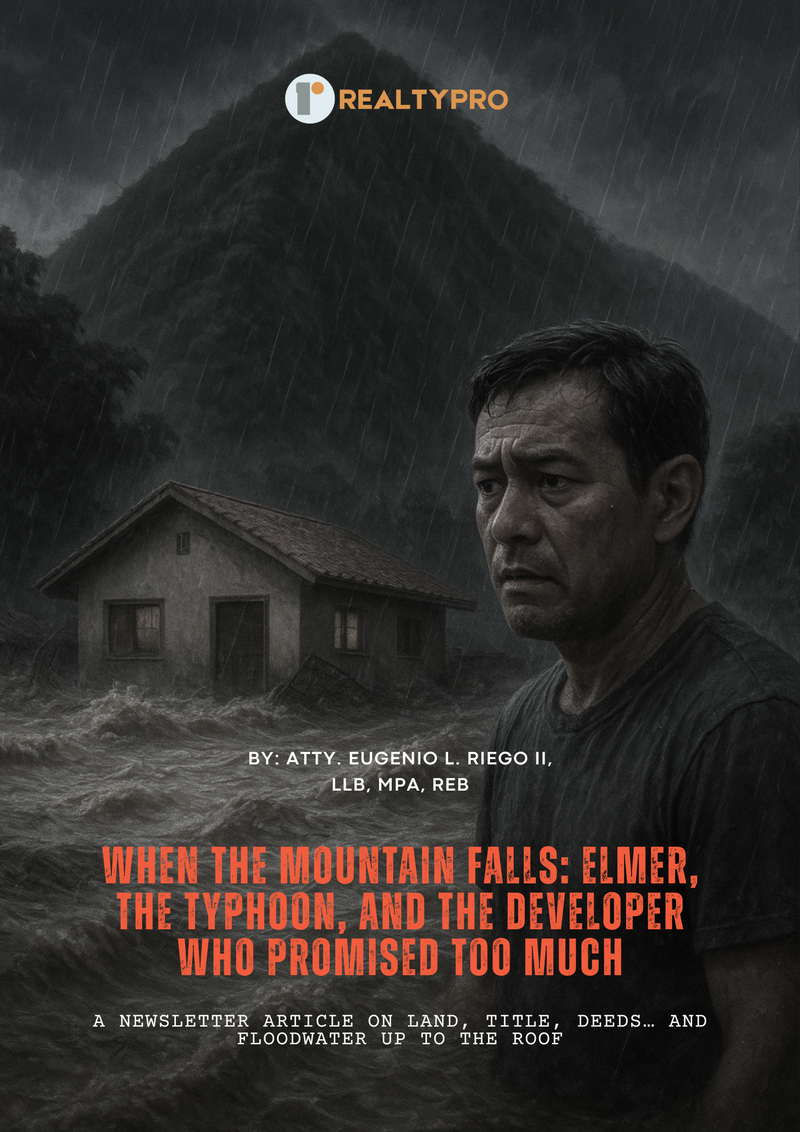

When the Mountain Falls: Elmer, the Typhoon, and the Developer Who Promised Too Much
A Newsletter Article on Land, Title, Deeds… and Floodwater Up to the Roof
By: Atty. Eugenio L. Riego II, LLB, MPA, REB
The Situation
Elmer was a practical man—an engineer by profession and, as he proudly claims, “a graduate of YouTube University in DIY home repairs.” He worked hard, saved wisely, and early in life invested in a modest home at the foot of a mountain somewhere in a southern city where typhoons were supposed to be rare.
Back then, the area looked like a provincial postcard: a serene river, a mountain with trees, and fresh air that smelled like early retirement. He bought the land cheap—because no one else wanted it yet.
But then, progress marched in. The mountain behind his home suddenly turned into the next real estate goldmine. Developers—wealthy, powerful, and blessed with the confidence of people who believed gravity could be negotiated—rushed to buy and develop the mountainside.
Elmer became worried. Being an engineer, he was acutely aware of words like “soil erosion,” “water run-off,” “slope stability,” and “my house is below theirs.” So he approached the city officials, who assured him:
“Don’t worry, sir. The developers promised to comply with all environmental and safety requirements.”
Ah yes—promises. The same kind used by politicians during election season and friends during inuman sessions.
The developers, wanting quick returns on their multimillion-peso investment, decided to focus first on building the expensive houses and villas. The water-retention systems? The drainage upgrades? Soil stabilization?
Saka na yan, they said. “The south rarely gets typhoons anyway.”
But the weather had other plans.
Enter Typhoon Yohen, a storm so strong that even weather anchors looked genuinely stressed on TV. The river overflowed. The unfinished mountain development soaked, softened, and slid water downhill like it was auditioning for a disaster movie.
Elmer and his family woke up to brown floodwater knocking at their door like an uninvited tita during fiesta. Within minutes, their house was submerged. Good thing Elmer had built an escape ladder to the roof—“just in case.” Turns out, “just in case” arrived.
Many homes were destroyed. Some residents suffered tragic losses. Elmer, soaked and angry, demanded compensation from the developer.
The developer said:
“Sorry, sir. Fortuitous event po yan. Typhoon. Act of God. Not our fault.”
So, is the developer correct? Can they escape liability by invoking the magical phrase “fortuitous event”?
Legal Answer
Short answer: NO—developers cannot simply blame Mother Nature if negligence played a part.
While a typhoon is indeed a fortuitous event, it does not automatically exempt parties from liability. The Civil Code provides that for a party to be exempt from responsibility due to a fortuitous event, all these must be present:
- The cause of the breach must be independent of human will.
- The event must be unforeseeable or unavoidable.
- The event must render it impossible to fulfill an obligation.
- The obligor must not have contributed to the damage by any negligence, delay, or bad faith.
That fourth requirement is the developer’s downfall.
If the developer failed to install the required environmental safeguards, drainage systems, water-retention structures, or erosion controls—despite legal requirements and despite promising to comply—then their negligent acts contributed to the damage.
And when negligence joins the party, the defense of “fortuitous event” instantly dies.
Thus:
a. The developer cannot escape liability.
b. The typhoon alone is not the reason for the destruction—it was the combination of the typhoon and the developer’s failure to follow safety and environmental laws.
c. Elmer may claim actual damages, moral damages (yes, trauma counts), and even file administrative complaints.
The Relevant Supreme Court Case
National Power Corporation, et al. v. Court of Appeals, et al
G.R. No. 96410
In this case, the Court discussed that:
- Held that while typhoon “Kading” was an act of God, NPC’s negligence in the operation of the Angat Dam was the proximate cause of the damages. The evidence showed that the opening of the spillways was not gradual but sudden and simultaneous, and that the water level was maintained at maximum despite advance warnings of the typhoon.
- The Court emphasized that the act of God doctrine does not apply when human negligence concurs with the natural event in causing the loss. The rainfall during “Kading” was not extraordinary, and previous, stronger typhoons had not caused similar flooding, indicating that the disaster was not solely due to natural causes.
- The Court found that the warnings given by NPC were insufficient and ineffectual, as they were not delivered to responsible municipal officials who could have properly disseminated them to the residents. The notices did not reach the people most at risk, and the method of notification was inadequate.
- The Court rejected the argument that the damages were damnum absque injuria, as NPC’s negligence constituted a legal injury for which they are liable under quasi-delict principles.
The principle is clear:
“A fortuitous event does not shield a negligent party from liability.”
Applying this to Elmer’s case:
• The typhoon was natural.
• The massive flood damage occurring specifically because the developer failed to implement required environmental protections was not purely natural.
Therefore, the developer remains liable.
The Quick Advice
Buying property is like choosing a spouse—you must look beyond the pretty exterior and inspect what’s underneath. Does it have strong foundations? Does it have the capacity to withstand storms? Has it passed environmental clearance? And most importantly, does it come with drainage?
For homebuyers:
Therefore, always check the elevation, drainage systems, and environmental compliance of the site. Consult engineers, geologists, and lawyers—not just your tita who says, “Ay, maganda ang feng shui dyan.”
For developers:
If you build houses on a mountain, remember: gravity exists. Water flows downward. Soil erodes. And ultimately, negligence, like karma, always comes back—sometimes in the form of lawsuits filed by very wet and very angry homeowners.
Greed should never outweigh safety. It’s not enough to promise compliance—you actually have to comply. The law—and common sense—require it.
Because at the end of the day:
Better to invest in proper drainage now than to swim in liability later.
For Legal and Real Estate Assistance, Click Here
Want to know the latest Real Estate happenings? Visit – REALTYPROBLOG
#rltypro
